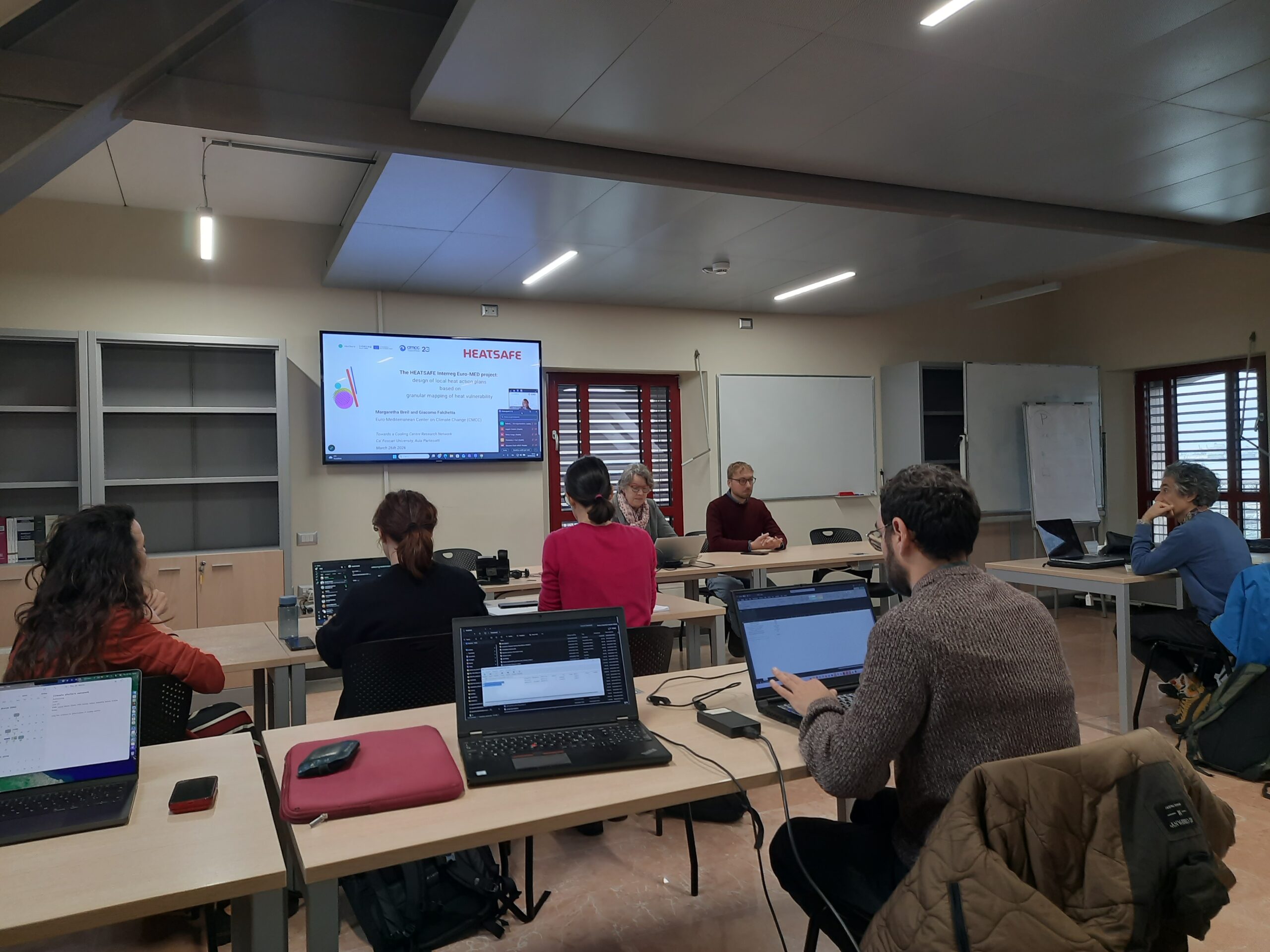

HEATSAFE partners Euro-Mediterranean Center on Climate Change (CMCC, Italy) and Metropolitan Area of Barcelona (AMB, Spain) participated in a hybrid workshop dedicated to research perspectives regarding climate shelters in Italy and Europe. The event “Towards a Cooling Centre Research Network” was held on March 26, 2026 at Ca’ Foscari University of Venice. The event was organized by Prof. Enrica De Cian and Catarina Midoes within the context of the energy humanities research cluster at the NICHE Center for Environmental Humanities activities at Ca’ Foscari.
The goal of the workshop was to bring together some of Italy’s and Europe’s existing cooling shelter, centre and refuge initiatives for the first time to explore the potential for establishing a Cooling Centre Research Network (CCRN). The CCRN would facilitate harmonised and coordinated data collection and analysis, the organisation of stakeholder events to exchange perspectives, communication activities to maximise the visibility and social impact of these initiatives, and, if feasible, work towards the co-creation of climate shelter specific guidelines and protocols for policymakers. The event counted with the participation of several research groups, specifically, the IUAV University of Venice, the Italian Red Cross, the University of Turin, Etifor, the Climate Office of the mayor of Rome, and CMCC.
CMCC presented the analytical work done for the HEATSAFE pilots on the identification of locally specific vulnerabilities, while AMB presented their experience in the creation of the extensive network of climate refuges in the Metropolitan area of Barcelona.
Important findings from the discussions held during the workshop regarded two key elements of climate refuges as part of a wider policy for the management of heat – and cold – related vulnerabilities in local contexts. The first one is that local vulnerabilities can be highly specific and localized, even within a municipal territory. Hot spots and areas of particular need can be analysed using socio-economic, climatic and morphological data of local contexts, but specific knowledge of local vulnerabilities is as important as the detailed analysis for targeted intervention and selection of spaces to be transformed in cooling centres. The second one is that, in order to be accepted as a protective solution for vulnerable groups, cooling centres must respond to clear co-designed conditions in terms of accessibility, comfort and general attractiveness, requiring targeted solutions, namely for specific groups like tourists or marginalized groups.
While public libraries appear in many cases suitable and easy to implement solutions, due to their distribution in the territory, personnel availability, and a certain level of flexibility of their spaces, they may not offer the most desired social environment for all groups. A differentiated offer for daytime activity can raise the attractiveness of these places where vulnerable people might need to spend an increasing number of hours during heatwave days.
Distance to the cooling center from the place of residence is an additional factor that may prevent the popular use of shelters. In particular in less densely urbanized areas, cooling shelters can be too far away from homes, and alternative solutions are needed to provide safe, thermally comfortable and inclusive access during hot days. To address some of these challenges, AMB is currently launching a pilot project of “micro-shelters” through proximity stores, such as pharmacies, accessible to larger population groups.
All presenters highlighted that climate shelters need to be part of a wider set of solutions for the protection of vulnerable persons during heat waves, requiring a suite of management actions ranging from early warning systems and improvements of the urban environment to tailored care services and continuous monitoring and reflection regarding the potential for improvement. “Climate refuges can be an important solution for addressing heat related vulnerabilities in cities, but they need to be included in holistic urban climate policies which aim at reducing urban heat impacts on the built environment”, stated Margaretha Breil, pointing to measures ranging from thermal improvement of buildings to the creation of cool outdoor spaces.
Capitalising on the existing experiences and strand of research on the topic, presenters were invited to discuss the creation of a Cooling Centre Research Network coordinated by CMCC and Ca’ Foscari University of Venice and CMCC. “Since climate change adaptation is generally under-represented in administrative, census data and population-based surveys, the network would provide an important opportunity to gather more evidence on adaptation and its potential trade-offs with mitigation” said Enrica De Cian. “Mapping and reviewing existing initiatives and data collected so far, as well as coordination on the next questionnaires are our short-term, next steps” concluded Catarina Midoes.