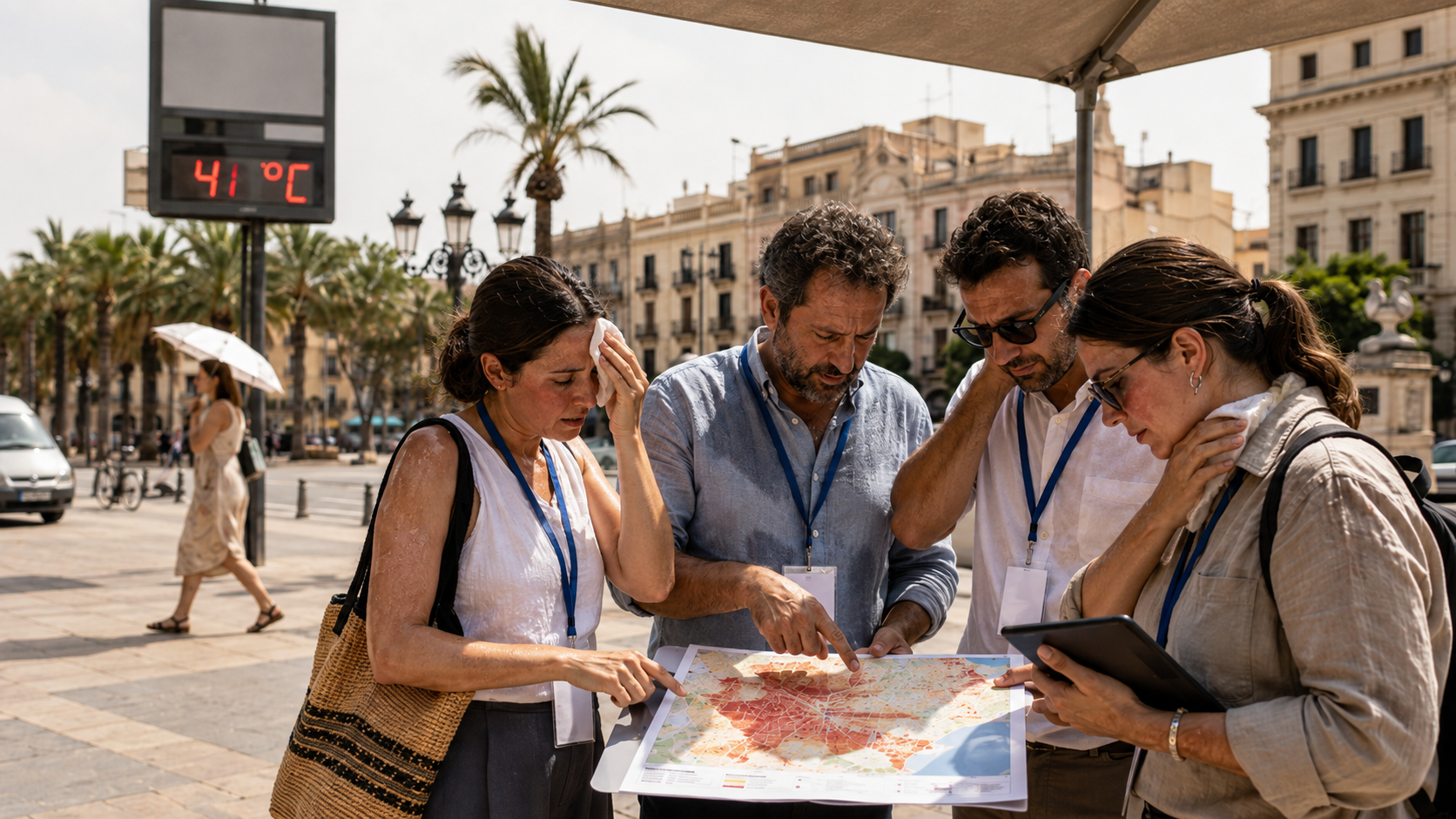

Image generated with AI.
Heatwaves are getting worse in Europe, especially around the Mediterranean. Scientists agree that this increasing frequency and intensity are related to climate change, and these are expected to become even more frequent in the future (IPCC, 2021). In summer 2025, climate change was responsible for 68% of an estimated 24,400 heat deaths across 854 European cities, having raised local temperatures by as much as 3.6°C (Barnes et al., 2025). During the late June 2026 heatwave alone, European countries reported more than 10,000 excess deaths (EUROMOMO, 2026).
Persons living and working in cities are at high risk during such periods, as temperatures in cities exceed those in nearby rural areas by up to 10 degrees Celsius (Santamouris, 2020). As extreme summer heat is becoming the “new normal,” countries and cities need to prepare. Heat health action plans (HHAPs) can help to prepare for, respond to and mitigate the health impacts of extreme heat, organizing the coordination of different actors which need to collaborate. HHAPs bring together a portfolio of actions and actors across preparedness, warning and response to reduce heat-related health risks through coordinated implementation across different sectors and levels of governance. They combine the organization of early warnings with clear actions to be undertaken during acute emergencies. Because they need lead time to set up the coordination mechanisms, they are prepared in advance and activated at the beginning of the summer season. They should also be regularly revised and improved at the end of each season, using an assessment of how they worked in practice (WHO, 2026).
National warnings need to be adapted locally to be useful. This means identifying vulnerable people, local hot spots of the urban heat island, and ill-protected buildings, using maps, data and local knowledge. Local measures can include cooling centres in libraries, schools, and community centres, addressing needs of vulnerable people and boosting health services to handle more calls. To increase resilience on the long term, cities also need to create more green space and shade.
As part of the support work for HEATSAFE project partners, we took stock of heat-health planning across the 14 Mediterranean countries: Albania, Bosnia and Herzegovina, Bulgaria, Croatia, Cyprus, France, Greece, Italy, Malta, Montenegro, North Macedonia, Portugal, Slovenia, and Spain. By 2025, 10 of these 14 countries had a national heat-health action plan.
While national heat-health plans represent an important support and driver for local action, neither does the existence of a national plan guarantee its translation into local HHAPs, nor does the absence of such a national policy framework represent an obstacle to local action. In Italy and Spain, where national HHAPs exist, local plans have also been developed in some cities. In countries without national HHAPs, cities have become active as well, either responding to the indications of national adaptation strategies that encourage local HHAPs, or drawing on dedicated urban adaptation plans to guide the development of new green and blue infrastructure. The city of Athens received funding and support from international city networks (C40 and 100RC) to create an ambitious heat resilience plan, and Plovdiv and Sofia in Bulgaria, as well as Larnaca and Paphos in Cyprus, have likewise created outdoor and indoor spaces serving as cooling refuges.
HEATSAFE brings together six pilot areas across five countries: the Regional Council of Durrës (Albania), the Association of South-Western Municipalities in Bulgaria (Blagoevgrad), the Municipality of Agioi Anargyroi-Kamatero (Greece), the Municipality of Arezzo (Italy), and the Barcelona Metropolitan Area and Municipality of Cartagena (both Spain). In the first project deliverable, each was assessed against the eight core elements the World Health Organization recommends for heat-health action planning, drawing on a questionnaire completed by the local partners and complemented by desk research. Readiness varies widely; yet a finding shared by every pilot area, and a central reason they joined the project, is that none yet has a complete local heat-health action plan, or a local version of a national or regional one.
That shared diagnosis is the starting point for the rest of the project. For each pilot area it sets out not only which of the eight elements are missing, but which already exist at national or regional level and could be adapted for local use, so that support can be matched to where each area actually stands. The review also points to a set of common priorities: grounding heat warnings in health data rather than temperature alone, as Albania and Greece would need to do; making sure those warnings reach the people most at risk; widening the definition of vulnerability to include social and economic disadvantage, as Spain’s national plan does; and building in the monitoring and evaluation of measures that no pilot area yet carries out. Building on this foundation, and on detailed local evidence of where heat and vulnerability overlap, HEATSAFE will work with each pilot area to develop the local heat-health action plans they currently lack and to turn the diagnosis into concrete, locally owned action.
Further readings:
Barnes, C. et al. (2025) “Summer heat deaths in 854 European cities more than tripled due to climate change.” Available at: https://doi.org/10.25560/123873.
EUROMOMO (2026) Graphs and maps, Graphs and maps. EUROMOMO, Statens Serum Institut. Available at: https://euromomo.eu/graphs-and-maps (Accessed: July 21, 2026).
IPCC (2021) “Summary For Policymakers,” in V. Masson-Delmotte, et al. (eds.) Climate Change 2021: The Physical Science Basis. Contribution of Working Group I to the Sixth Assessment Report of the Intergovernmental Panel on Climate Change. Cambridge, UK and New York, NY, USA: Cambridge University Press,. Available at: https://www.ipcc.ch/report/ar6/wg1/chapter/summary-for-policymakers/.
Santamouris, M. (2020) “Recent progress on urban overheating and heat island research. Integrated assessment of the energy, environmental, vulnerability and health impact. Synergies with the global climate change,” Energy and Buildings, 207, p. 109482. Available at: https://doi.org/10.1016/j.enbuild.2019.109482.
WHO (2026) HEATHEALTH ACTION PLANS GUIDANCE second edition. Copenhagen, Denmark: WHO Regional Office for Europe, p. 272.
DOWNLOAD: Diagnosis of heatwaves action planning in the Mediterranean area