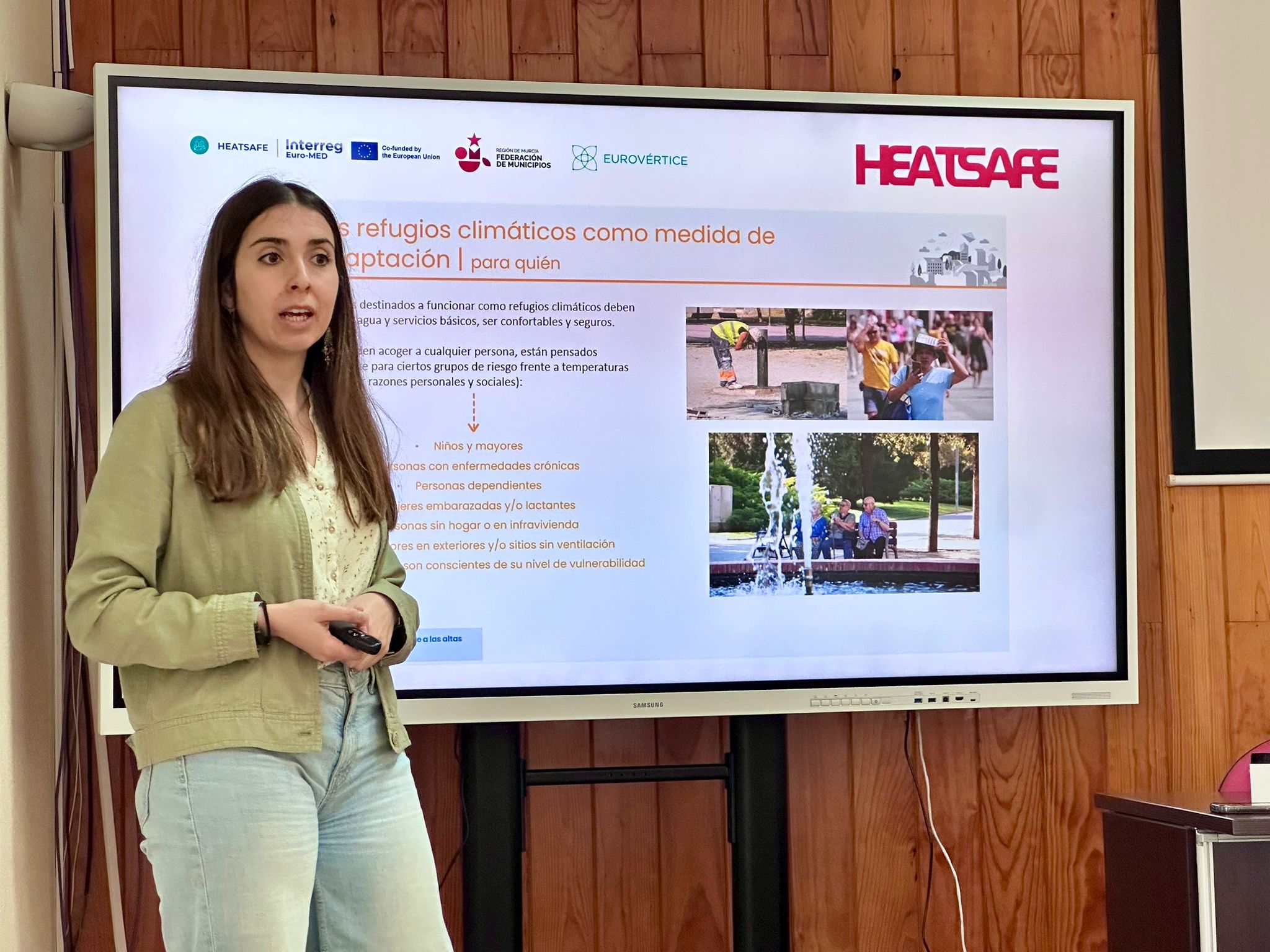

The project first governance meeting has made it possible to identify vulnerable groups, map existing resources and detect opportunities to strengthen coordination between local actors
The governance structures of the Euro-MED HEATSAFE project in its six pilot territories — Agii Anargiri-Kamatero (Greece), Blagoevgrad (Bulgaria), Durrës (Albania), Arezzo (Italy), Cartagena (Spain) and the Barcelona Metropolitan Area (Spain) — have demonstrated their usefulness as shared working spaces for providing essential information to adapt local action plans for high temperatures to local realities.
In these first meetings, designed and coordinated by EuroVértice, public administrations, emergency services, social entities, community organisations and scientific institutions collaborated to analyse vulnerability to heatwaves in the urban areas of the five municipalities and the Barcelona Metropolitan Area, and to move towards more coordinated and effective responses. Prior to the meetings, each territory carried out a mapping of key stakeholders, identifying local entities with direct knowledge in areas such as risk management, support for vulnerable groups, urban planning, public health and community action.
The methodology of the sessions was structured around two dynamics. The first focused on identifying the most vulnerable groups and assessing their exposure to extreme heat. To this end, participants placed the different groups on a sociogram according to their level of exposure and their adaptive capacity, identifying those that will require special attention because they combine high exposure with a lower capacity to respond.
The second dynamic made it possible to identify the resources available in each territory and analyse how coordination between local actors could be improved. The participating entities shared the actions they are already carrying out, the resources they have available and the main needs identified to strengthen the response to extreme heat episodes.
The comparative analysis of the results from the five municipalities and the Barcelona Metropolitan Area shows a clear convergence in the identification of the most vulnerable groups. Indeed, the relationship between climate vulnerability and certain social and economic factors became clear.
Among the priority groups identified in most territories were older people, children and adolescents, people on low incomes, workers directly exposed to heat, and people with disabilities or health problems. This does not mean that specific elements did not emerge in each municipality, linked to the importance of tourism, the characteristics of the urban fabric or the existence of consolidated networks of climate shelters. This highlights the importance of an exercise such as this for addressing local realities.
With regard to resources, the meetings made it clear that there is a combination of institutional capacities, public infrastructure and community networks that can contribute to improving the response to heatwaves. The resources identified include civil protection and emergency services, social services, and air-conditioned public facilities with the potential to function as climate shelters.
It is worth noting that social and community organisations are perceived as especially important because of their capacity to act as direct communication channels with citizens. In this regard, the meetings have shown that working with local entities, based on their specific knowledge of each territory, is essential for identifying the key actors that can play this proximity role.
One of the main results of this first stage of the process has been the shared recognition of the need to strengthen coordination between public administrations, emergency services, social entities and community organisations. Although alert systems and communication channels vary between territories, all participants agreed on the importance of moving towards clearer protocols, common messages addressed to citizens and better communication between local and regional levels. These are precisely some of the aspects that HEATSAFE will continue to work on in the next phases of the project.