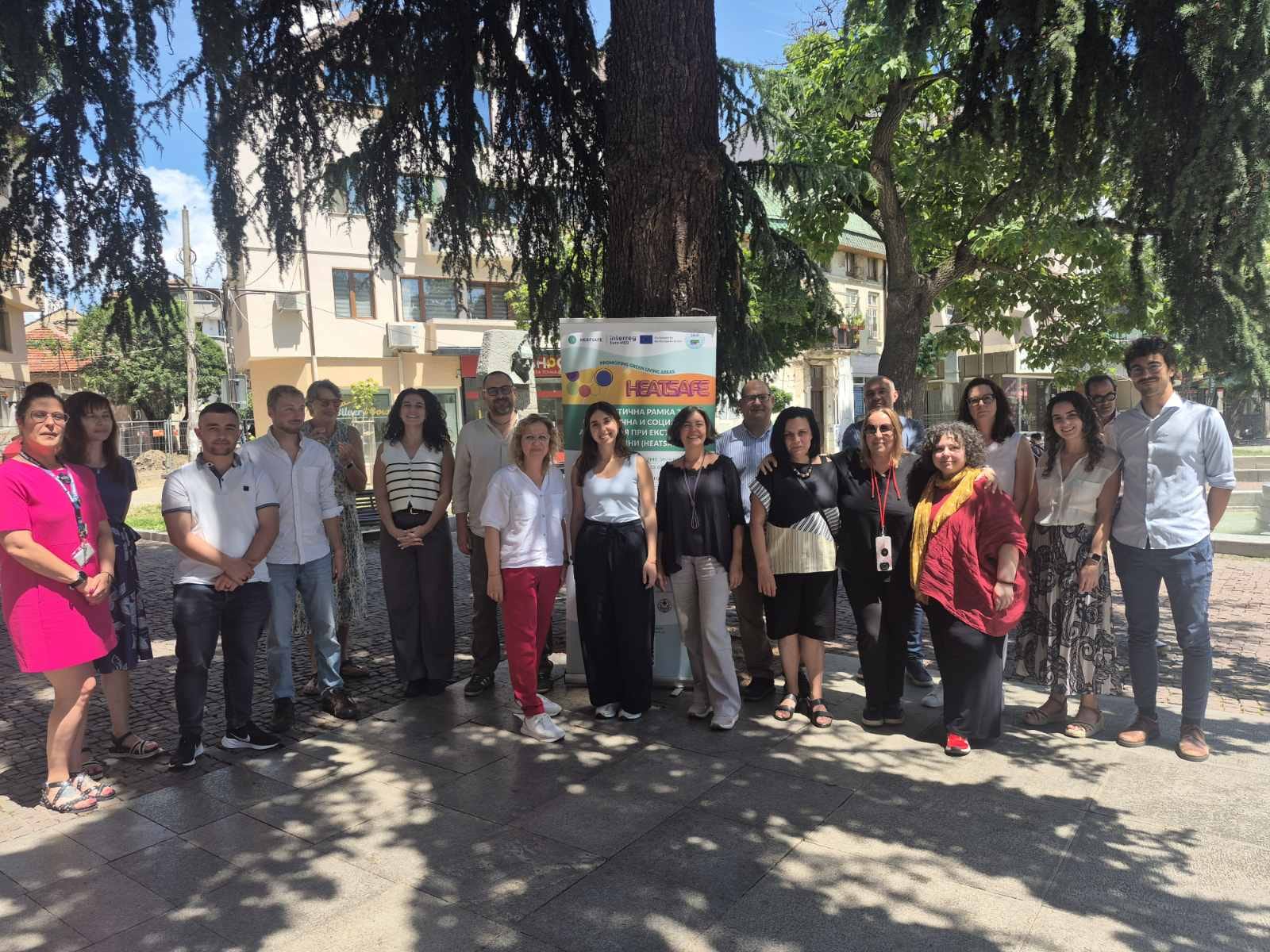

The technical visit to Blagoevgrad strengthens Mediterranean cooperation to improve the prevention, mitigation and management of risks associated with heatwaves
The team of the European project HEATSAFE – Holistic Environmental and Social Adaptation Framework for Extreme Heat has taken part in a technical visit to Blagoevgrad, Bulgaria, as part of the activities carried out by this initiative to improve the adaptation of Mediterranean cities to the increasing frequency and intensity of extreme heat events.
During the visit, project partners made progress in exchanging knowledge and defining common methodologies to strengthen municipalities’ capacity to respond to the impacts of climate change, with particular attention to the protection of the most vulnerable populations, adaptive urban planning and local response to heatwaves.
HEATSAFE, co-funded by the Interreg Euro-MED programme, is coordinated by the Federation of Municipalities of the Region of Murcia and brings together organisations from several Mediterranean countries with the aim of designing transferable solutions based on territorial cooperation, scientific evidence and local participation.
The HEATSAFE consortium is made up of the Federation of Municipalities of the Region of Murcia, as project coordinator; EuroVértice Consultants; the Barcelona Metropolitan Area; the Municipality of Agii Anargiri – Kamatero; the Association of South-Western Municipalities; the Regional Council Durres; the Municipality of Arezzo; the National and Kapodistrian University of Athens; and the Fondazione Centro Euro-Mediterraneo sui Cambiamenti Climatici – CMCC. Together, these partners bring complementary expertise in local governance, urban planning, climate science, risk management and Mediterranean territorial cooperation.
The meeting in Bulgaria provided an opportunity to further develop one of the project’s core areas of work: the creation of local action plans to address extreme heat, adapted to the social, urban and climate characteristics of each territory. The partners also worked on tools to identify areas and groups with higher exposure to heat-related risks, in order to support decision-making by local authorities.
Among the project’s most relevant actions are the development of heat vulnerability maps, the implementation of demonstration pilot actions, the creation of open tools for heat risk assessment and the design of a long-term strategy to help improve climate resilience in Mediterranean cities.
The visit to Blagoevgrad also made it possible to share experiences on urban adaptation solutions, such as the identification and improvement of climate shelters, the introduction of rapid response measures during high-temperature episodes and the promotion of awareness-raising campaigns aimed at citizens.
The HEATSAFE project responds to an increasingly evident reality: heatwaves are one of the main climate risks for Mediterranean cities, particularly affecting older people, children, people with pre-existing health conditions and socially vulnerable groups. To address this challenge, the initiative proposes an integrated approach that combines planning, innovation, local governance and community participation.
With this visit, the HEATSAFE consortium continues to move forward in building a common model for adaptation to extreme heat that can be replicated in other Mediterranean territories, contributing to safer, healthier and more climate-resilient cities.
About HEATSAFE
HEATSAFE is a European project co-funded by the Interreg Euro-MED programme. Its objective is to improve the prevention, mitigation and management of risks arising from climate change and the increasing frequency and intensity of heatwaves in the Mediterranean. To achieve this, the project works on the co-design of local action plans, the implementation of demonstration pilot actions and the development of open tools to assess heat vulnerability and support public decision-making.